
What’s the difference between rooibos and green rooibos teas? This post compares their origin, processing, appearance, and flavor profiles.
Rooibos, or red bush tea, is generally more well known then green rooibos. Both herbal teas come from Aspalathus linearis. This plant is “a South African shrub from whose leaves a tea (infusion) is made that is high in antioxidants, and has low tannin content and no caffeine” (American Botanical Council).
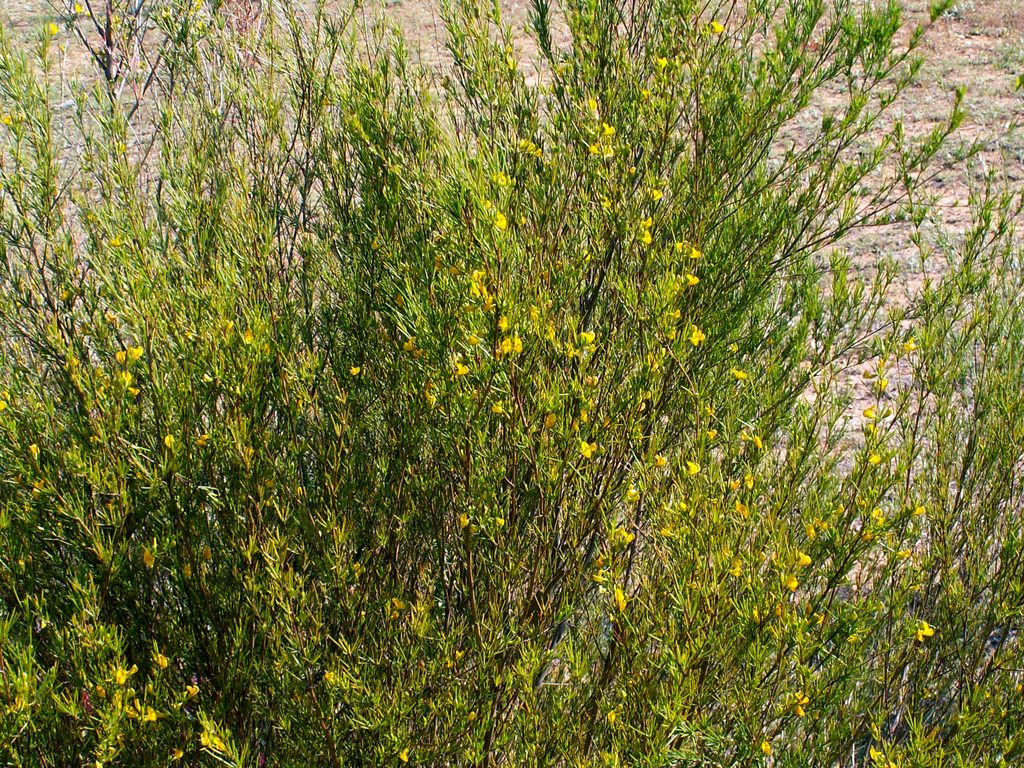
This plant grows in the mountainous areas in Cederberg, South Africa. Although both types of the tea made from this plant contain antioxidants, “[g]reen (unfermented) rooibos tea has higher levels of antioxidants, while fermented rooibos tea has a sweeter taste” (Louw and Rooibos ltd.).
Processing, Leaves, Steeped Tea
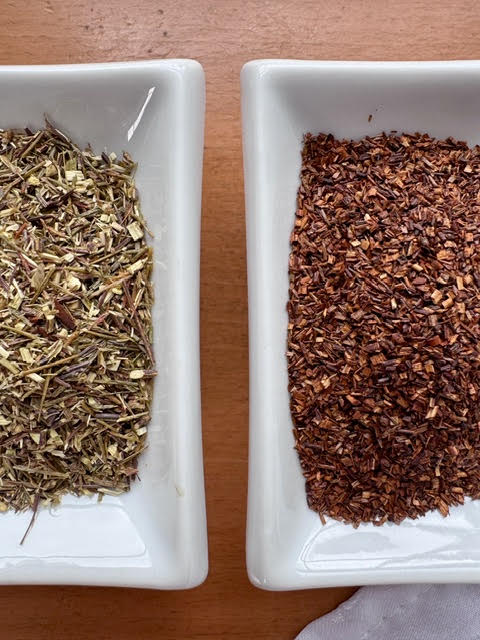
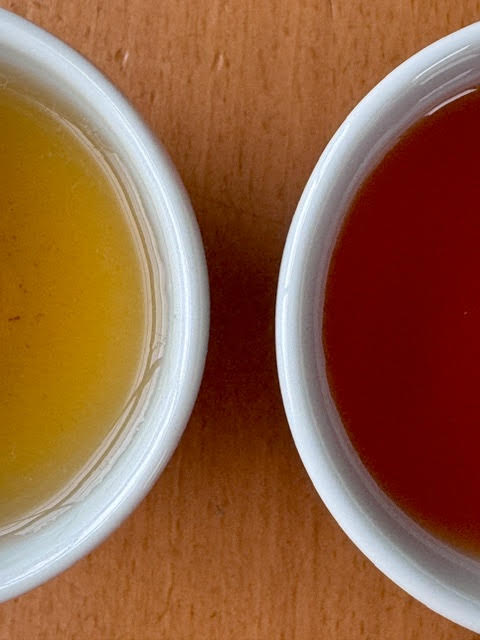
Green rooibos leaves do not go through process that encourages oxidation, making the dried leaves predominantly yellow-green with some flecks of brown. Rooibos, by contrast, goes through the oxidation process. Thus, its leaves are mahogany brown. These color differences in the leaves come out even more pronounced in the colors of the steeped tisane, as seen in the photos below.
Rooibos and Green Rooibos Tasting Notes
I was perplexed when I started comparing different online tasting notes for rooibos and green rooibos online. Apparently, I find more similarities between them than many others do. There could be many reasons for different tasting notes. For example, physiology, food and flavor experience, water composition, and preparation can influence tasting notes.
I steeped both herbal teas the same way: I used water just off the boil, near 212F or 100C. I used about a teaspoon of tea per 8 ounces (235 ml) of water. Some tea websites, I later noticed, recommended a lower temperature for green rooibos. I’ll have to try that when I restock. Since Adagio Teas* recommended 100C, that’s what I used…and enjoyed!
There are layers of flavors in both steeped herbal teas. I’ll try to pin a description to a few of them. Both the rooibos and the green rooibos have bright and deep notes. The biggest difference, to me, is that the deeper notes are predominant in the rooibos and the brighter notes are more noticeable in the green rooibos.
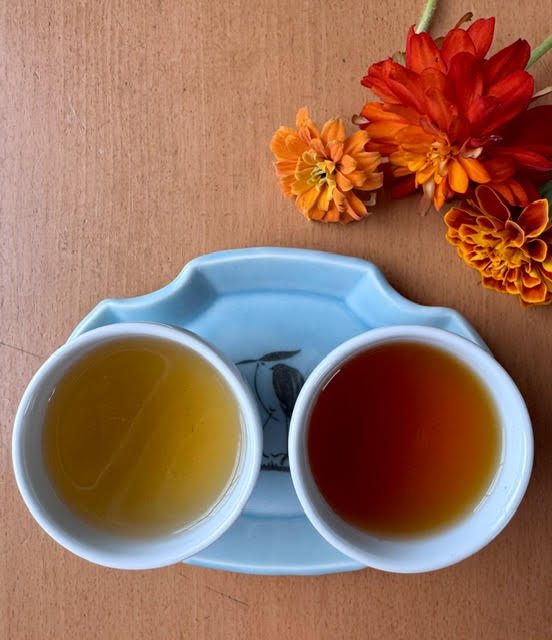
The rooibos also has a more pronounced creamy vanilla flavor. Both have very pleasant “woody” flavors. If I had to pin down a difference between rooibos and green rooibos there, I’d say that green rooibos has more of the popsicle stick woodiness to me. (IYKYK) Some tea companies noted more vegetal flavors in the green rooibos. I didn’t find that at all. But, as noted above, I didn’t try steeping the green rooibos at a lower temperature.
Different Ways to Enjoy Rooibos
Both of these teas steep up with a lovely complexity and flavors that I enjoy very much without adding other flavors. I also enjoy Rooibos Vanilla–that combination pumps up the natural vanilla notes that I enjoy in an unflavored rooibos.
I’ve also enjoyed green rooibos steeped with cracked green cardamom pods and/or a pink rose bud or two added. In fact, I offered a blending experience to a local group of tea lovers in April. The green rooibos–plain and with these additions–was a big hit.
I like to steep regular rooibos double strength and then add milk sometimes. (This preparation is delicious hot or iced.) Steeped this way and hot, it is close to the color and density of drinking black tea with milk–how I grew up drinking tea. (The flavor is different from black tea with milk. But, I really like it!) Side note: As I’ve written before, our tea experience is about more than the flavor.
I’ve also had rooibos chai blends that I’ve really enjoyed.
Health Benefits and Risks
Rooibos and green rooibos contain antioxidants, as mentioned above. Although small studies have suggested more specific health benefits, as Healthline notes, “health claims relating to the tea are often anecdotal and not based on strong evidence.”
Always consult your doctor before regularly drinking an herbal tea. Be extra cautious if you have any health conditions. For example, Memorial Sloan Kettering Cancer Center mentions a couple of reported cases of liver toxicity for heavy drinkers of rooibos. They also state: “Rooibos tea has antioxidant effects and may interfere with the action of certain chemotherapeutic agents.” So, again, talk to your doctor about the potential risks of ANY herbs–including rooibos or green rooibos tea.
Bottom Line, Other Herbals, and Sources
I embrace the differences between rooibos and green rooibos teas. I thoroughly enjoy a cup of either, particularly in the evening when it’s too late for me to drink caffeine if I want to sleep well.
If you are interested in other herbal teas, my posts about other tisanes may interest you.
Sources:
American Botanical Council. (n.d.) “Rooibos, Aspalathus linearis.” https://abc.herbalgram.org/site/SPageServer?amp;pagename=AAH_Rooibos Accessed August 29, 2026.
Healthline. (2026). “5 Health Benefits of Rooibos Tea (Plus Side Effects).” https://www.healthline.com/nutrition/rooibos-tea-benefits. Accessed August 31, 2026.
Louw, Marinda and Rooibos Ltd. (n.d.) “Rooibos Tea Production.” https://southafrica.co.za/rooibos-tea-production.html. Accessed August 31, 2026.
Memorial Sloan Kettering Cancer Center. (February 22, 2023). “Rooibos Tea: Purported Benefits, Side Effects & More.” https://www.mskcc.org/cancer-care/integrative-medicine/herbs/rooibos-tea. Accessed August 31, 2026.
Photos:
All photos, except one, were taken by me. Photo of the Aspalathus linearis plant by Winfried Bruenken via Wikipedia, used under Creative Commons ShareAlike 2.5.
Note:
* I’ve bought tea from Adagio Teas many times over the past five plus years. My experience has always been very positive. I’ve also specifically purchased (at full price) rooibos, green rooibos, and rooibos vanilla herbal teas from them. Out of the blue this summer, however, they reached out to offer me some free samples. I chose to receive rooibos and green rooibos samples so I had them both at the same time to compare and write this blog post. I always disclose when I get free or reduced teas. Also, I only accept them with the understanding that I don’t have any responsibility to post unless I sincerely enjoy them. You can see my complete review policy here. Honesty and transparency are important to me.