
How To, Why, and Tips
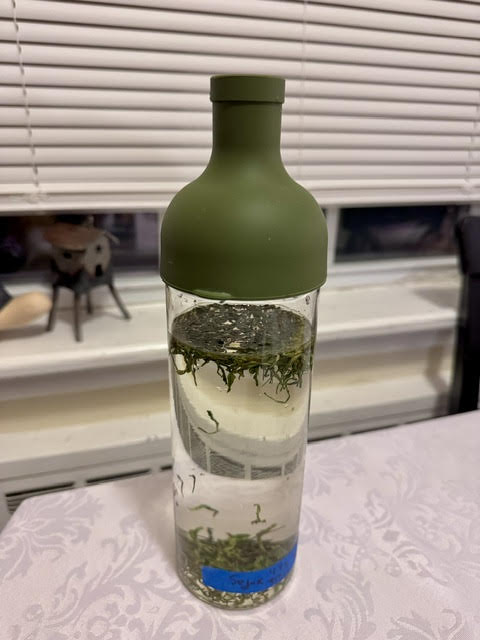
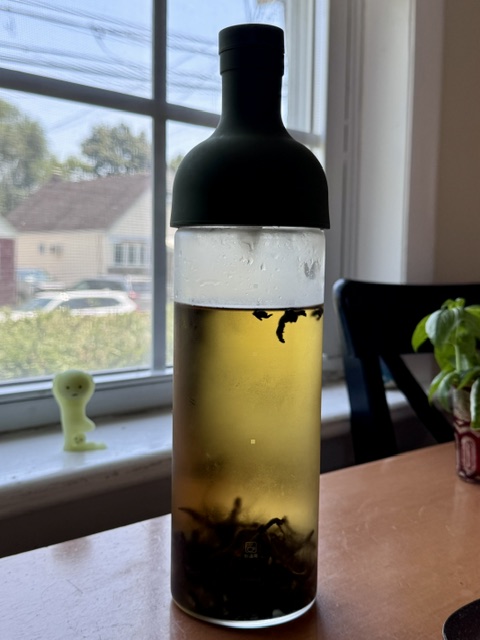
Cold brewing tea usually involves putting tea leaves (or tea sachets) into room temperature or cold water. Then, you store it in the refrigerator from a few minutes to 12 hours to allow it to steep. You never use hot water. This method is called mizudashi (水出し) in Japanese, according to the Global Japanese Tea Association.
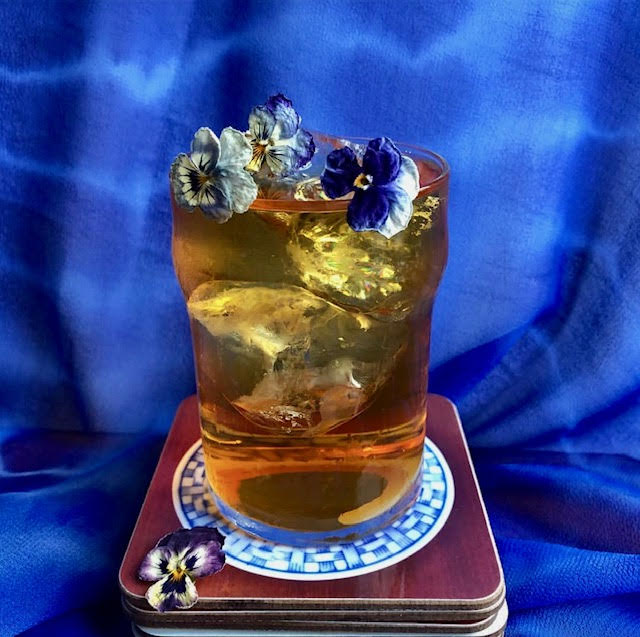
What Are the Advantages of Cold Brewing Tea?
We don’t have central air conditioning in our old house. So there are days when the window units are straining and it’s uncomfortably warm. In this kind of weather, making cold-brewed tea means we don’t have to turn on our kettle or heat water. So, it’s energy efficient and can help keep your home environment cooler.
Cold brewing can also change a tea’s flavor profile in ways you might enjoy! There is evidence for Japanese green teas, for example, that the tea tastes sweeter and more umami when cold brewed.
Japanese green tea that is cold brewed also contains less caffeine than when steeped at its normally recommended temperature. But, you can try cold brew for any kind of tea. It doesn’t have to be a Japanese Green.
How Does Cold Brew Impact Caffeine Level and Taste?
The temperature at which a tea is steeped is important. It influences how fast and the extent to which different components in the tea leaves are released–for example, caffeine and tannins. When certain teas are steeped at a cooler temperature, they can yield a sweeter infusion with less astringent tannins and lower levels of caffeine.
Interested in more information about this? Sugimoto provides useful details regarding the differences in caffeine, etc., by temperature for a handful of specific Japanese green teas. For some caveats about how the outcomes can vary by tea types, check out Sciences Thé. He has a useful post on the variations and limitations of what we know about how cold brew impacts what is in your iced tea.
How Is Cold Brew Tea Different from Sun Tea?
Cold Brew differs from “sun tea” in that the latter involves using cold or room temperature water and then sitting the carafe in the sun while it steeps. Many of us have probably enjoyed tea this way; however, it is not a safe way to steep tea. Southern Living, for example, reports that a spokesperson at the FDA (the Food and Drug Administration in the U.S.A.) cautions:
“The tea may not reach temperatures high enough to kill harmful bacteria and the water temperature during sun tea brewing typically is within the ‘danger zone’ where bacteria can thrive, allowing growth of bacteria that can cause illness.”
Honestly, you can get very similar results much more safely by using a cold brew method, so why gamble with creating bacteria?
Finding Your Preferences
I’ve enjoyed many teas cold brewed. Interestingly, although I tend to use less tea than many hardcore tea drinkers when I prepare my tea hot, I find I often appreciate more tea leaves in my cold brew.

For example, I love Soocha Tea’s Korean teas. When I cold brew Sejak or Balhyocha, however, I prefer it when I use a higher leaf-to-water ratio than Soocha’s website recommends. Roughly speaking, they recommend a little over 4g of Sejak for 750 ml or about 3 cups. But, I prefer around 7g, even if I let the tea steep 12-18 hours. Of course, it could be the room temperature of the water, the difference between my water in Long Island and the water in Toronto, and/or personal preference.
All of this is to say experiment to find what you like and how you like it steeped!
One tip: cold brewing smoky teas have been the least predictable for me! For me, it’s hard to predict when the smokiness will cold brew balanced versus when it is intensified by the cold brew.
Other Tips and Approaches
To get more tips or to learn about different approaches to making sparkling iced tea, I’ve got you covered in the blog posts below!
2 replies on “Cold Brewing Tea”
I love my cold steeper from Volition Tea! Nepal Collective’s First Flush cold steeps well twice, with a hot steep before I finally get rid of the leaves.
Thanks for sharing your cold steep tips, Janet! I think Volition carries the same Hario cold brew bottle that I have. It’s so useful! I haven’t tried hot steeping the leaves after making a cold brew. I definitely need to try that.